Jentic Tech Talk
The newsletter for teams building AI that actually ships. Covering APIs, AI agents, open standards, and enterprise architecture.
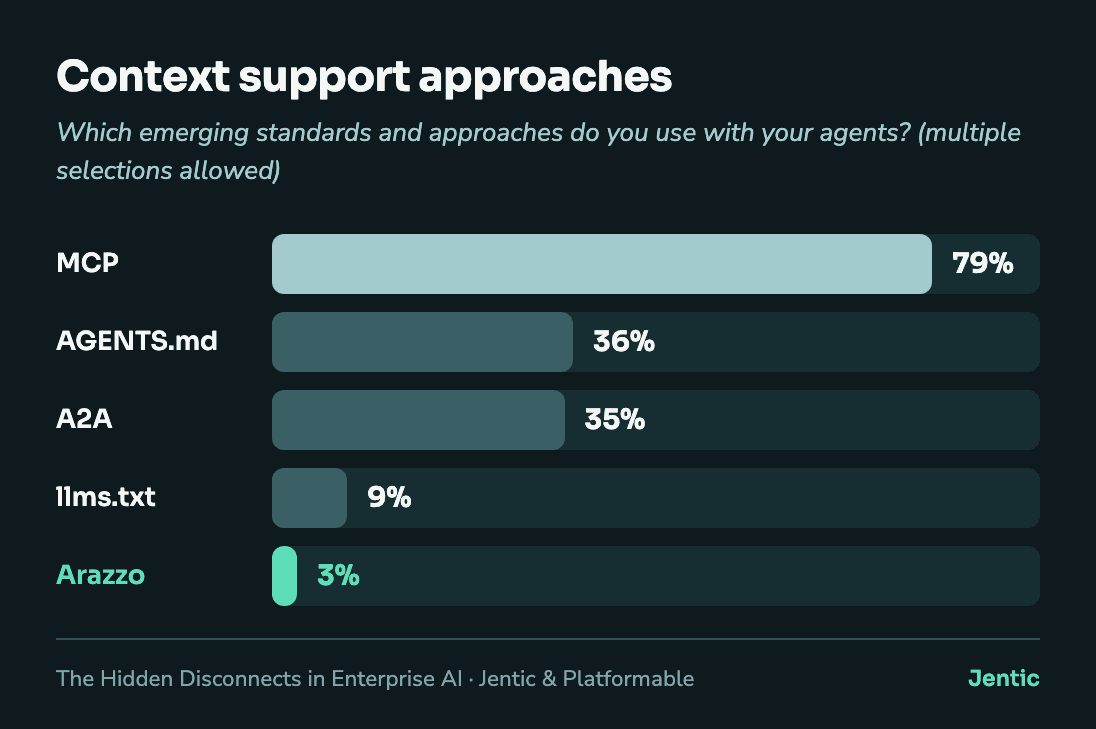
79% of teams give their agents MCP. 3% give them Arazzo.
We asked 114 practitioners which standards they use to give agents context, for our research with Platformable.
Most teams now give agents tools. Almost none give them the steps. MCP tells an agent what it can call; Arazzo tells it the order, and how data moves from one call to the next. For teams already writing Arazzo workflows, that is an early lead. And Arazzo acting as declarative capabilities make for the best MCP tools too!
The same survey found 67% have APIs used by business agents, but only 30% have checked those APIs are ready for them. The report maps six disconnects like these, drawn from 183 industry reports, 114 practitioner surveys and 16 enterprise interviews across 27 countries, each with a platform response you can act on.

Actor-in-the-Loop: The Arazzo 1.X Proposal
Arazzo describes deterministic sequences where each step calls an operation, data flows forward, and the workflow runs to completion. That model covers most of what enterprise integration workflows need. What it cannot yet describe is the moment when a workflow must stop, present a situation to an actor, and wait for a response before it can continue.
The patterns that require this are not edge cases. A buy-now-pay-later checkout finds that three of five items cannot be financed, and the customer decides whether to proceed with the eligible items, switch payment methods, or cancel. A deployment pipeline has validated a change and assessed the risk, but an operator must sign off before any infrastructure is touched, potentially hours later. An OAuth authorisation code flow requires a human to navigate to an authorisation server, authenticate and consent, and the result arrives as a query parameter in a redirect callback, not as an API response.
The formal proposal adds a first-class interaction field on a step with three modes:
- formstructured actor response, described with JSON Schema- redirectOAuth-style flows, where a browser or user-agent is in the mix- acknowledgesimple approval gates
Timeout handling is declared as an ISO 8601 duration with an explicit onTimeout branch defining what happens if no response arrives. Once an actor responds, the validated response flows into downstream steps as normal outputs, with no special casing required. There is a natural alignment with MCP’s Multi Round-Trip Request pattern: an Arazzo executor running as an MCP tool host can map interaction steps to InputRequiredResult and resume statelessly across any executor instance.
OpenAPI’s Overlay Specification 1.2 Released
The Overlay Specification, the OpenAPI Initiative’s standard for modifying API descriptions without touching the source document, released version 1.2 on September 22nd. Two additions address friction that practitioners running Overlays at any real scale will recognise.
Reusable Actions
A new components.actions section lets you define an action once and reference it from any number of targets via $ref. Adding a standard error response, injecting a security requirement, or inserting a missing summary across twenty paths now means writing it once and referencing it twenty times. References can override individual fields from the component, so a shared base action can still be tailored per target without duplicating the whole block.
Portable Document Identity
Overlay documents now carry their own URI. When $self is set, relative URIs in extends resolve against that identity rather than wherever the file was retrieved from, so the same Overlay works correctly whether pulled from a CI runner, a local filesystem or a registry. A related tightening: extends and $self can no longer contain URI fragments. Anyone using fragment-scoped extends in 1.1 will need to adjust before upgrading; everyone else changes the version field and is done.
From Developer Experience to Agentic Experience at APIAddictsDay26
Benjamin Granados (Head of Global AI Community at Santander, MIT Faculty Collaborator) gave a talk at APIAddictsDay26 on October 17th that maps the shift from developer experience to agentic experience in terms worth paying attention to. Developer experience is about reducing time to first call. Agentic experience, in his framing, is about how easily an agent can access, understand, and operate within a product to achieve a user-defined goal. That is not a matter of degree. Developers read documentation and retain context across sessions. Agents execute intent, have no tolerance for ambiguity, lose context between chained calls, and break silently when something does not match their expectation.
The data he cites, from the 2025 Postman State of the API Report, makes the gap concrete: 24% of teams currently design APIs with AI agents in mind; 60% still design primarily for human developers. The five shifts he identifies that agentic consumption demands (discovery, deterministic workflows, agent identity and security, observability, governance) map directly onto the dimensions the Jentic AI Readiness Framework measures.
He names the Jentic scorecard and Arazzo explicitly as the tools for addressing the workflow layer, with a worked Arazzo example in the slides.
— CONFERENCES & EVENTS
Watch the latest webinars on demand, or join us at our latest events
Have an idea for a webinar topic you’d like to see us cover? Send us an email.
AI Native Week Berlin
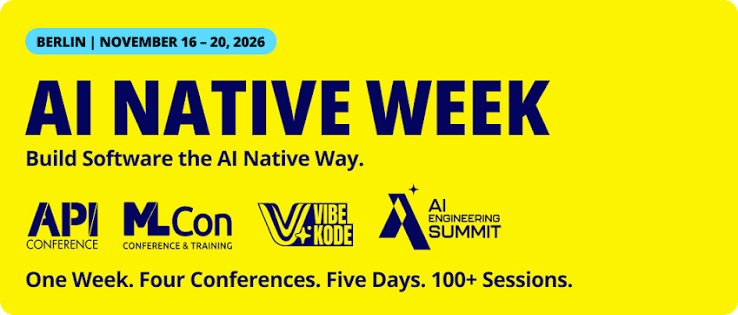
Catch me in Berlin next month. AI Native Week runs November 18–20, with Jensen Huang (NVIDIA) among the keynotes. I’m speaking on the 19th (15:45–16:30): Beyond OpenAPI: Workflows That AI Agents Can Actually Execute, on why OpenAPI alone does not give agents enough to work with for multi-step execution, what Arazzo 1.1 adds, and what that means for teams connecting agents to enterprise systems.
On the 20th I’m running a full-day workshop (09:00–16:30): Building AI-Ready APIs with Agent Skills. Seven modules, hands-on throughout: OpenAPI improvement with agent skills, Overlay-based governance, and Arazzo workflow modelling. The target is architects, platform engineers, and developers already dealing with agents hitting their APIs.
The Hidden Disconnects in Enterprise AI
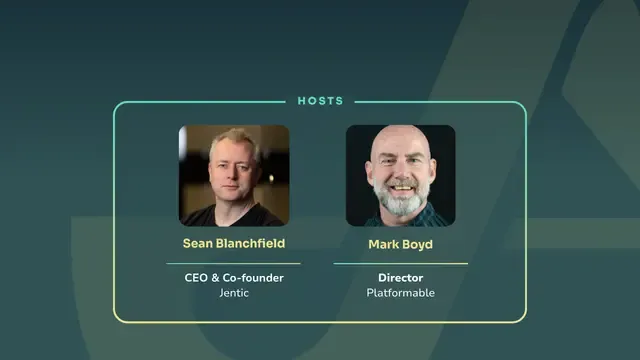
Sean Blanchfield (Jentic CEO) and Mark Boyd (Platformable) walk through the research findings: where measurement breaks down across enterprises, what symbolic security looks like in practice, and what the organisations that moved successfully from pilot to production did differently. The second half is a live Q&A. Available on demand now.
Making AI Agents Reliable Event-Driven API Consumers with Arazzo
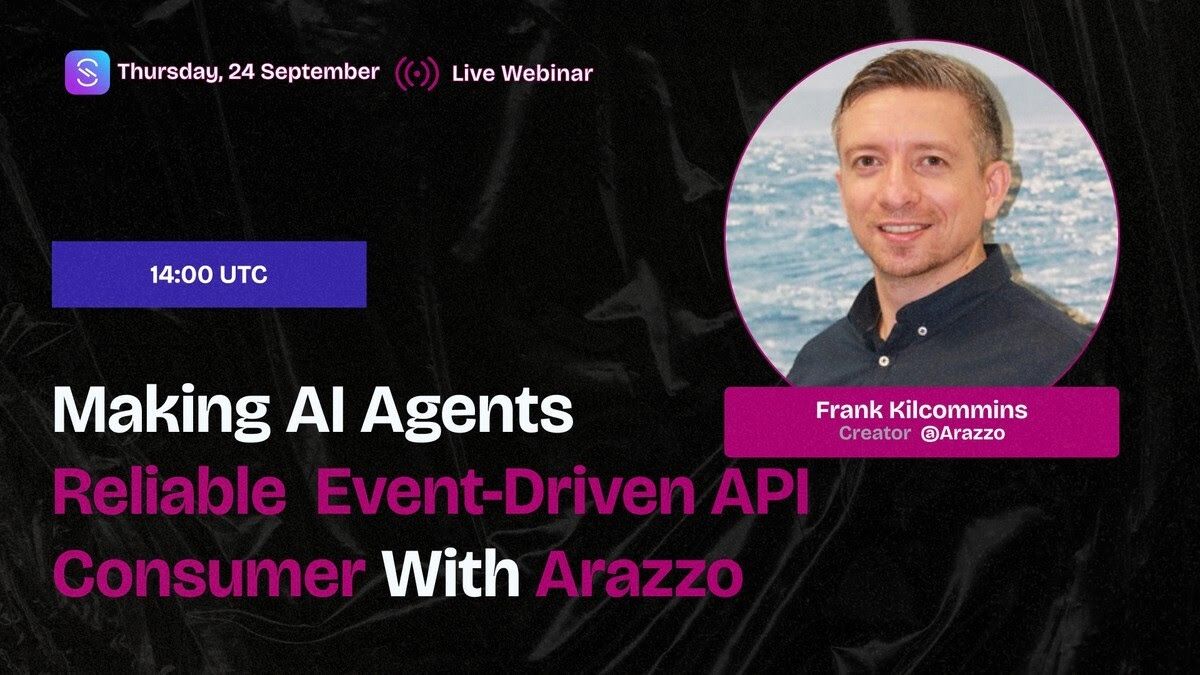
Catch up on the session with Frank and Azeez Elegbede (AsyncAPI Initiative), where they discussed the AsyncAPI support that landed in Arazzo 1.1. You can now point to AsyncAPI v3 documents alongside OpenAPI ones, giving your agents real knowledge of how your system actually behaves.